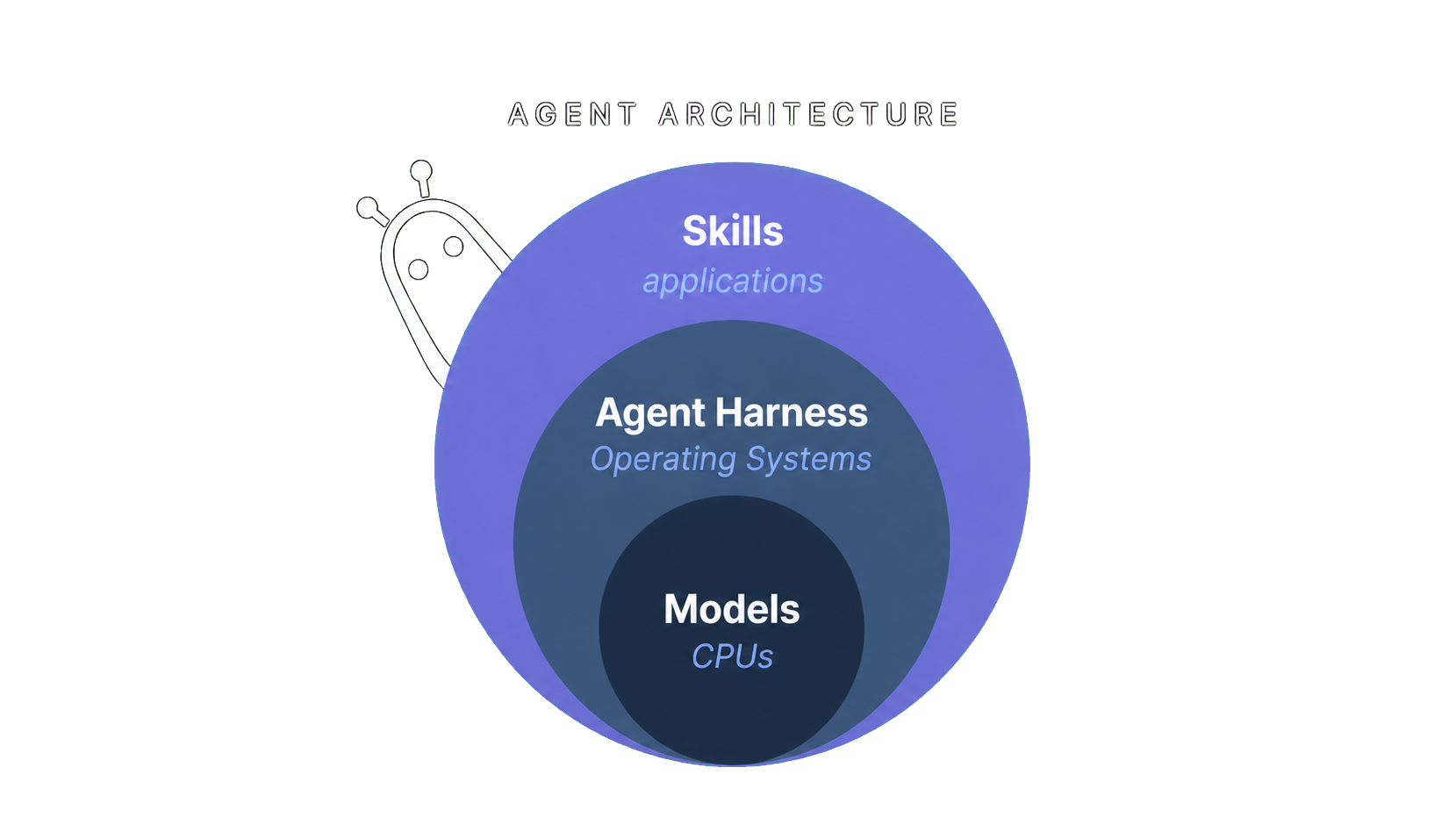
Foundation models are powerful, but power alone does not mean an agent knows how your team works. Skills close that gap by turning a general-purpose agent into a domain expert without retraining the model.
There are two common ways to make AI more useful: fine-tune a model on your data or write a longer system prompt. Both have limits. Fine-tuning is expensive, slow to update, and difficult to maintain when a workflow changes. A long prompt takes up context and still cannot stay focused on the knowledge that matters for the task in front of it.
Skills are a third path. A Skill is a self-contained, portable package of procedural knowledge that an agent loads at inference time, only when the work calls for it.
The idea in plain language
Think of Skills like apps on an operating system. The hardware is the foundation model. The operating system is the agent harness. You install the right app for the job, use it when needed, and keep the rest of the system unchanged.
A Skill captures the steps a practitioner follows, the conventions of a specialist domain, or the standard operating procedure your team uses every day. That kind of knowledge is rarely present in general training data, but it is what separates a technically correct answer from one that works in practice.
Every Skill is defined by a SKILL.md file. It combines a machine-readable configuration with plain-language instructions for the agent. When a request matches the Skill, the agent loads the relevant knowledge at the right moment.
What the research shows
In February 2026, SkillsBench published a large benchmark study on how Skills affect agent performance. Researchers evaluated 7,308 agent trajectories across 84 tasks in 11 domains, using seven agent-model configurations and three conditions: no Skills, curated Skills, and Skills generated by the model itself.
Source: SkillsBench, Li et al., February 2026. Read the Study
Three findings matter most. Curated Skills, authored by people who understand the domain, improved performance across every configuration tested. The gains were especially strong in specialist fields such as healthcare, manufacturing, and finance because those workflows depend on procedural knowledge.
Models also could not reliably author the procedural knowledge they benefited from consuming. Self-generated Skills produced little or no average improvement. Precision, domain knowledge, and alignment with how practitioners actually work matter more than simply having more instructions.
Finally, focused Skills covering two or three coherent modules outperformed sprawling documentation. Smaller models equipped with well-crafted Skills were able to match larger models without them, which matters when teams are balancing capability and cost.
How Skills work in Miito
In Miito, Skills are part of the platform rather than an afterthought. Each one includes a SKILL.md file with its configuration, permissions, allowed tools, available surfaces, and instructions. Skills can also include scripts, reference documents, and templates that an agent can consult or execute in a controlled environment.
- Layered accessSkills can be controlled at the organisation, user, surface, environment, and trust levels.
- Explicit permissionsEach Skill declares the tools and external endpoints it can use, so work stays within the boundaries your organisation sets.
- Three sourcesUse built-in Skills from the platform, custom Skills authored by your admins, or Skills installed from ClawHub.
The SkillsBench findings line up with what Cypress AI's consulting team sees in practice. The gap between what an agent can do out of the box and what it can do with expertly authored, domain-specific Skills grows as the work becomes more specialised.
From general purpose to useful in practice
Skills do not replace the people who own the work. They give those people a consistent starting point, keep source material close, and make the best version of a workflow easier to repeat.
Back to Skills